
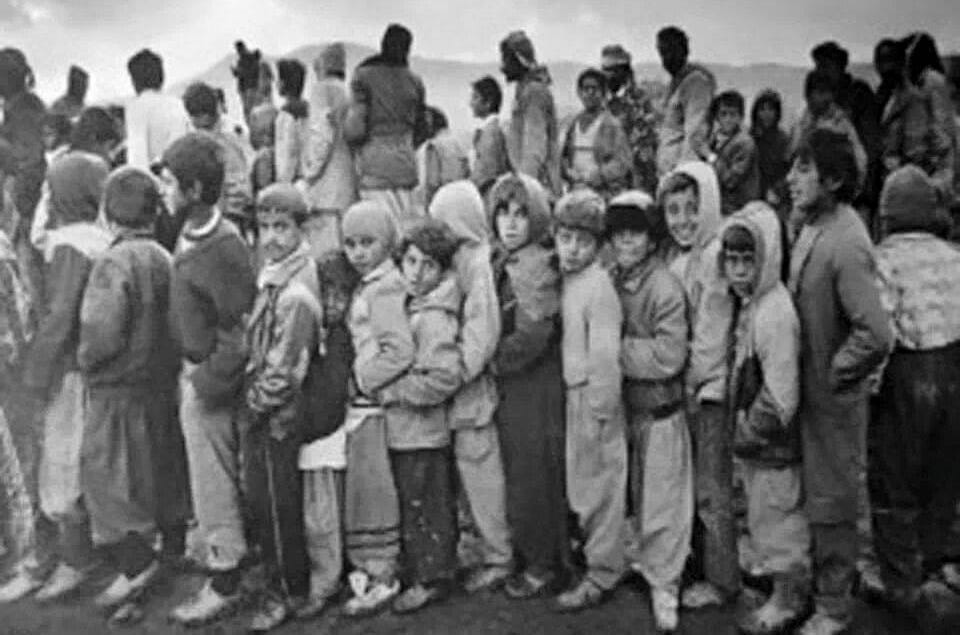
April is the month in which many nations and people commemorate acts of genocide committed against them on the basis of ethnic, religious, and/or political differences. Kurds, Jews, Cambodians, and Armenians all share this fateful month to reminisce about the calamities that came upon their past generations. On April 14, Iraqi Kurds commemorated the Anfal genocide campaign. Jews all over the world commemorated the horrors of the Holocaust on April 15/16; Cambodians commemorated their Killing Fields on the 17th. Armenians commemorate the 100th anniversary of the first documented genocide of the 20th century on April 24th.
As we humans commemorate past foolish collective actions, other parts of the world are boiling with ethnic, racial, and religious hatred at alarming levels.
The 20th century witnessed many large-scale genocides; some gained more notoriety than others, leaving us wondering if the 21st century is going to be any better. Although this young century hasn’t witnessed large-scale genocide campaigns, there have been many small-scale ethnic cleansing acts by irregular groups and forces. With most of the Middle East on the edge of sectarian wars, conditions are ripe for a wide-scale genocide to crown this century. Unless we make peace with our ugly past, acknowledge the mistakes of our ancestors, and shun all kinds of genocidal acts, we are bound to witness more acts of violence aimed at wiping out certain groups of humans based on perceived differences.
Defining Genocide
The Merriam-Webster dictionary defines “genocide” as the deliberate killing of people who belong to a particular racial, political, or cultural group.
And the United Nations defines genocide and ethnic cleansing in Articles II of the 1948 Convention on the Prevention and Punishment of Genocide as the mass expulsion or killing of members of an unwanted ethnic or religious group in a society.
Background
History tells us that on or about April 24, 1915, the first group of intellectuals and community leaders of Armenian descent, about 200 total, were expelled from the capital of the Ottoman Empire, Constantinople. The discrimination against Armenians was based on ethnic as well as religious differences. The Ottoman Empire was the guardian of the Muslim world, and it subjugated all other religious minorities, including the Christian Armenians. The systematic prosecution continued until the fall of the Ottoman Empire and its replacement with the present Republic of Turkey in 1923. By then the reported two million strong Armenian population in Turkey had shrunk to almost zero. Half of the population had become victims of the oppressive Ottoman rule and lost their lives, and the rest were able to, or were forced to, leave the lands ruled by the Ottomans.
To date, only several countries have recognized the blatant acts of ethnic cleansing of Armenians as genocide. The world’s only superpower, the United States, is not one of them. When the issue was put before the House of Representatives in 1975, President Ford was concerned that such a recognition would affect the strategic relations with the US’s strongest ally in the region at the time, Turkey.
Genocide Chronicles
Since the years of genocide against the Armenians, humanity has been witness to many similar shameful acts. Some were planned out and implemented by governments and superpowers, and some were the actions of groups against smaller or less powerful groups. Nevertheless, the definition of genocide can be applied to all of them regardless of their source and the scale of the atrocities.
The Jewish Holocaust (1941 – 1945)
One of the largest campaigns of ethnic cleansing and genocide in history is the Nazi-German-led Holocaust to wipe out the existence and identity of the Jewish population in the world. In this campaign, it is estimated that a total of 6 million Jews were killed, including close to a million children. The Holocaust is the most known and the most studied act of genocide in the world, due to its horrific scale and the number of accomplices; close to 500,000 individuals are believed to have been directly involved in the planning and execution of this act of genocide.
Khmer Rouge Killing Fields Genocide (1975 – 1979)
On April 17, Cambodians commemorate the genocide that is known worldwide as the Khmer Rouge Killing Fields. During the rule of the Khmer Rouge in Cambodia, close to a million Cambodians were killed. The mass killing was considered part of an organized government campaign. The communist Khmer Rouge-led government, in essence, arrested and killed anyone suspected of ties of allegiance to the former government. A United Nations-sponsored investigation estimates the number of civilians killed as a result of the Khmer Rouge’s policies, which included starvation, deprivation from health services, and denial of employment opportunities, close to seven million.
The Anfal Campaign (1986 – 1988)
Named after a verse from the Muslim holy book of the Qur’an, the government of Saddam Hussein and his ruling Baath Party set out on an ethnic cleansing campaign to wipe out the Kurdish population in northern Iraq. This state-sponsored campaign included arresting adult and young men, killing them in groups, and burying them in mass graves. Close to 90 percent of all villages in northern Iraq were leveled to ground. Children and women were placed in camps, the women frequently sexually raped and sometimes sold as prostitutes. The campaign reached its peak when the government used chemical gas against the town of Halabja and killed 5000 civilians. It is estimated 500,000 civilians were killed in this campaign.
Bosnian Genocide (1992 – 1995)
The Bosnian Genocide is in reference to the systematic and targeted killing of the Bosniaks, meaning the Muslim Bosnians, by Bosnian Serb forces during the Bosnian War. An estimated 8 to 8.5 thousand Bosnian men and boys were killed, and close to 3000 civilians were forcefully removed from their homes and the regions they had lived in for generations. This genocide was mostly religion-based, with an ethnic influence.
Rwandan Genocide (1994)
The mass murder of members of the Tutsi tribe as well as some moderates from the Hutu tribe was committed by the majority Hutu in a period of about 100 days. An estimated 500,000 to 1,000,000 Rwandans lost their lives as a result of this mass ethnic cleansing. This genocide was the byproduct of the Rwandan Civil War between the Hutu-led government and the Rwandan Patriotic Front, mainly Tutsi, that began in 1990.
Darfur Genocide (2003)
The Darfur genocide was carried out by the Sudanese government against the non-Arab population in Sudan. In February 2003 the Sudan Liberation Army and the Justice and Equality Movement began taking action against the government of Sudan as a result of the alleged oppression by the Sudanese government of non-Arabs in the Darfur region. The Sudanese military and the Janjaweed militia, made up of Arab tribal fighters, responded with an ethnic cleansing campaign of non-Arabs resulting in the death of hundreds of thousands of civilians.
Yazidi and Christian Genocide (2014–2015)
In June of 2014, the world had a rude awakening to a new genocide aimed at terminating the ethnic Yazidi Kurds and converting Assyrian/Chaldean Christians to Islam or facing death. The Islamic State in Iraq and Sham (ISIS or ISIL) had expanded its territory, crossed the border from Syria to Iraq, and occupied the second largest city in Iraq, Mosul. On the western side of the city of Mosul lie the town of Sinjar and Mount Sinjar, home to the Kurdish Yazidi minority that practices a form of Zoroastrian religion known as Zardashti, named after their prophet Zardasht. The region also houses a large number of Iraqi Christians who have been inhabitants of this region for thousands of years. ISIS applied the zero-tolerance policy towards the Yazidis and began killing hundreds to thousands of them, forcing children, women, and old men and women to flee to Mount Sinjar for refuge. Those who failed to escape in time were subjected to slavery, rape, and death. The cleansing campaign against the Yazidi Kurds was the fiercest and a priority because, to ISIS, the Yazidi were the true infidels who were idol worshipers. Then ISIS turned its attention to Christians and offered them three options: conversion to Islam, paying tax, or death. Many Christians managed to buy back temporary safety by paying the levied taxes, leaving their homes and belongings at the mercy of looting ISIS thugs, and left for safer places under the control of the Kurdistan Regional Government.
SIS continues to target Christians and Yazidis, as well as Shiites living in the territories they presently control and the new places they occupy on regular bases.
Outlook
It is hard not to sound like an alarmist when all the signs point to a future that holds more genocidal action. For example, in Iraq the levels of hatred among the many different ethnic and religious groups are at their highest. The rift between Shiite and Sunni Arab groups is only getting wider and deeper. Kurds and Arabs are fighting it out on a daily basis on college campuses, social media, and satellite TV channels. Yazidi Kurds accusing other Kurds of failure to protect them. Christian Iraqis feel betrayed by the rest of the Christian world for standing by as they were ousted from their ancestral homes and lands. The introduction of the Iran-backed Popular Mobilization Front to the Iraqi mess frightened and angered Kurds as well as more of the Sunni Arab population, Christians, and other minorities. In Iraq, all the above constitute indicators for a possible collective action of one group against one more of the other groups in the form of a genocide. The possibility of such events is magnified by the absence of a unifying message from the central government. The Iraqi government itself is so divided it is incapable of delivering a message of unity.
Saudi Arabia and Iran are fighting proxy wars all over the Middle East; Yemen is the latest battlefront. Egypt is executing Muslim Brotherhood members right and left. Turkey is fighting for its past glory, at times acting like a rebellious teenager on the world stage.
In Africa, the Somali militant group al-Shabaab has been consistent in committing genocide, albeit on a relatively smaller but more effective scale, against Kenyan civilians. The recent attack on a college campus in Garissa, Kenya, prompted the Kenyan government to request the closure of the largest refugee camp in the world, Dadab, which is used to house Somali refugees. Al-Shabaab has a strong base of sympathizers in the camp and has managed to pull recruits from the young men living in the camp.
In Nigeria, Boko Haram is waging a war against the Christian majority, kidnapping and enslaving women based on their religious affiliations.
Pope Francis, possibly inadvertently, angered the Turks by referring to the Armenian ethnic cleansing as a genocide. Turkey, a country that has denied that the killing of Armenians was a genocide and has failed to make peace with its past to allow for wounds to heal, recalled its ambassador to the Vatican and requested an explanation for the Pope’s remarks. In Turkey also, the neo-Ottomans angered the secular Turks and other non-Muslim Turkish minorities by allowing Islamic Friday sermons and Qur’an recitation at the Hagia Sophia mosque in Istanbul for the first time in 85 years.
There are other hot spots around the world, such as Ukraine, but since my focus is on the Middle East and North Africa region, I will suffice by mentioning it for the record.
Conclusion
The human race has the obligation to condemn and ban all acts of genocide. Wars are inevitable; it has been proven throughout history. However, genocide should not be an inevitable part of wars. Treaties and agreements won’t stop rogue states and groups from committing genocide. Countries should reconcile with their past to enable the affected countries and peoples to get closure. Perpetrators should be dealt with in the harshest way possible to show that we as humans have evolved and we no longer have an appetite for such barbaric acts. The United Nations should dedicate a day to anti-genocide. A day in which school children all over the world are reminded of the horrors of such group actions against groups that are different from them. Maybe by being more upfront with ourselves and our future generations, by talking about what we as humans have allowed to happen in the past, we can have a chance to stop future genocidal acts.
This article was first published on a personal blog in 2015.