
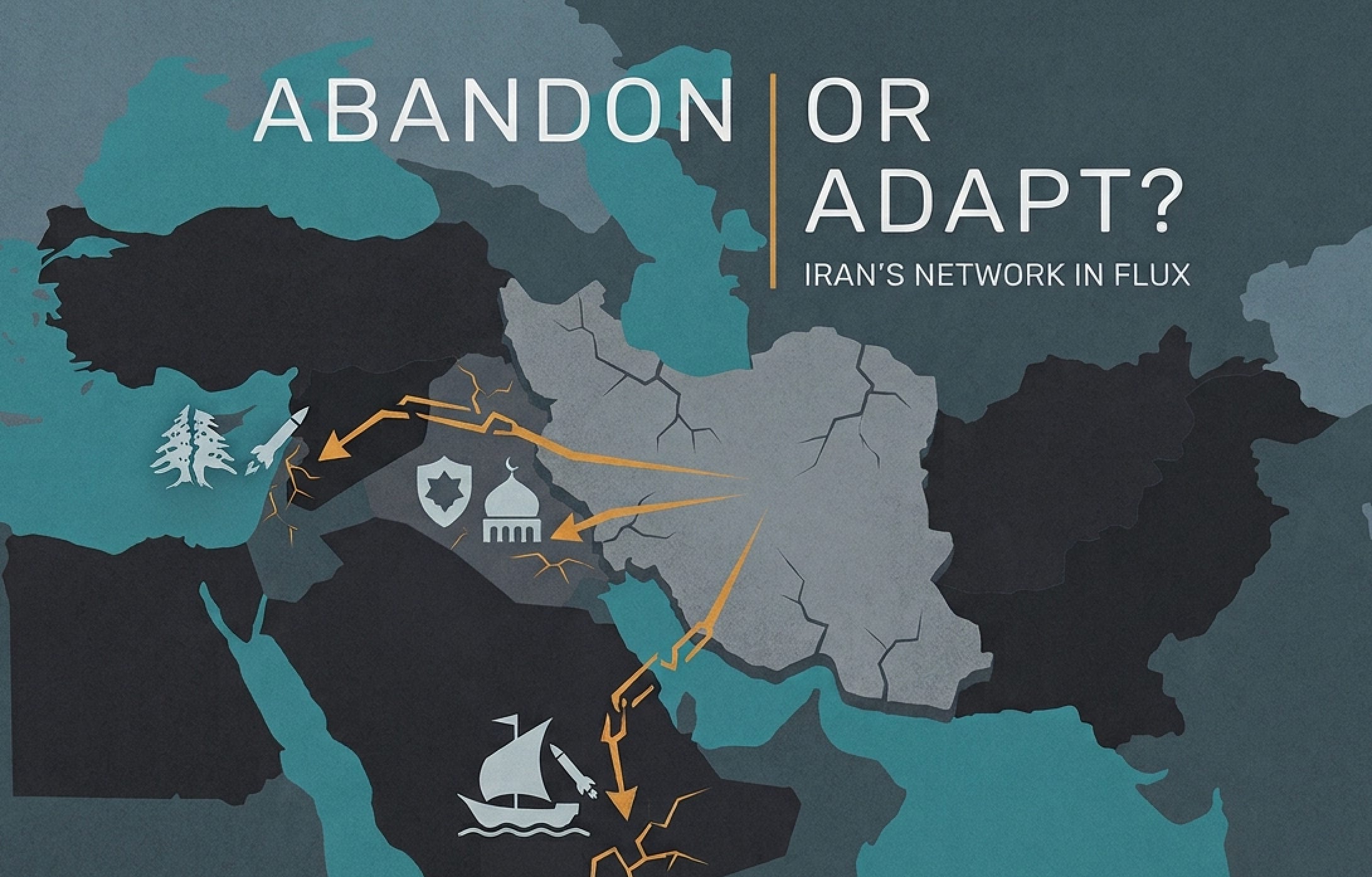
Barely eight months separate two wars that Iran fought against Israel and the United States. During the Twelve-Day War in June 2025, Iran’s regional partners (Hezbollah, the Houthis, and Iraq’s Popular Mobilization Forces) largely stayed on the sidelines. In the far larger war that began on February 28, 2026, several of the same actors took up arms: Iraqi militias struck U.S. and Kurdish positions, and the Houthis fired on Israel and moved against Saudi shipping lines. Does that shift mean Tehran will conclude proxy warfare failed and should be abandoned, or that it worked and should be continued in some adapted form?
The short answer is continuation. That conclusion is probabilistic, not settled. The “network” behind it is less unified than the term implies, and it competes with other plausible explanations for why 2026 looked so different from 2025.
2025: Proxy Inaction
The Twelve-Day War was, by the standards of what followed, a contained conflict. Israeli and American strikes targeted Iran’s nuclear and missile infrastructure over less than two weeks, ending in a ceasefire brokered by Washington. Iran’s own posture throughout was one of what regional analysts described as “strategic patience,” a reluctant recognition that it could not sustain a prolonged direct confrontation.
Its partners largely stayed out of the fight, though not for identical reasons. The Belfer Center for Science and International Affairs argued that none of Iran’s proxies acted in any significant capacity to aid Tehran during the war and suggested this reflected Iran’s own concern about losing its proxies were they to act. Israel’s INSS reached a similar conclusion, noting that members of the Axis of Resistance offered little more than condemnation of the strikes, held back by domestic pressure, diminished capabilities, and fear of Israeli or U.S. counterstrikes. The reasons differed by faction. The Houthis, rather than escalating in solidarity, moved to downplay Iranian and Hezbollah involvement in Yemen altogether, a decision plausibly shaped as much by Yemen’s own fragile post-truce politics as by any regional signal from Tehran. Hezbollah’s restraint had a more mechanical explanation: the group had already absorbed heavy losses in its 2024 campaign against Israel and was in no condition to open a new front, regardless of what Tehran wanted. Iraqi militias stayed quiet for reasons that likely had more to do with domestic Iraqi politics, particularly an already fraught debate over disarmament and the militias’ place in the state, than with any unified position across the network.
Read in isolation, 2025 looked like evidence that Iran’s decades-long investment in “forward defense” had produced a network that would not answer the call when it mattered. The Belfer Center went so far as to frame this as the degradation of Iran’s proxy model, though it was careful to note the network was diminished rather than defeated. That caveat matters. What looked like a common failure across three very different organizations may have been three separate, locally driven decisions that happened to point the same direction.
2026: Proxy In Action
The war that began in February 2026 was not simply a repeat of 2025 at a greater scale. Its opening act, according to reporting that is still being pieced together and corroborated, was a joint U.S.-Israeli strike that killed Iran’s Supreme Leader Ali Khamenei along with a number of senior officials. The exact toll, timeline, and command sequence remain unsettled and should not be treated as fixed facts. What followed, in broad terms reported across multiple outlets, was a leadership transition that installed Mojtaba Khamenei and weeks of continued strikes on Iranian territory. Some coverage at the time cautioned against equating the strike with regime change outright, noting the Islamic Revolutionary Guard Corps remained the state’s institutional backbone even as U.S. and Israeli officials framed regime change as the campaign’s objective.
Four explanations compete for why 2026 looked different, and they are not equally weighted. The strongest explanation is that a war aimed at the regime’s survival raises the stakes for the network built to defend it in a way a narrower war over nuclear infrastructure does not. Proxies that could rationally sit out a punitive strike had far less room to sit out a fight over the survival of the system that sustains them. This is the throughline of this commentary, and the explanation is best supported by timing: the shift in proxy behavior tracks the shift in the war’s stated objective more closely than it tracks any other single factor.
Three others likely reinforced that dynamic without driving it on their own. Reduced patron restraint is probably the next strongest: in 2025 Iran appeared to actively discourage proxy engagement to protect the network from destruction, and with Tehran’s own survival at stake in 2026, that restraint may simply have been lifted. Operational recovery is plausible but harder to weigh. Roughly eight months passed between the two wars, arguably enough time for Hezbollah, Iraqi factions, and the Houthis to partially rebuild capabilities disrupted in 2024 and early 2025, though not enough to explain why factions with intact capacity in 2025, like parts of the PMF, still held back. Local opportunism is the weakest as a general explanation, though it likely mattered at the margins for specific actors. Iraqi militias had their own stakes in the domestic disarmament debate, and the Houthis had their own stakes in Yemen’s internal politics and Red Sea revenue, independent of any signal from Tehran.
A shift in escalation thresholds, the sense that a second round of confrontation was less unprecedented and therefore less risky once the region had already survived one, is worth naming too, though it reads more as a byproduct of the other three than a distinct cause.
The reported record from the 2026 war does show a shift from 2025, even if individual figures within it need caution. Rudaw reported that the umbrella group of the Iran-backed Islamic Resistance in Iraq, which overlaps with the PMF, sided with Tehran once the campaign began in late February. Kurdistan24 cited PMF Commission statements putting the toll above 165 airstrikes and roughly a hundred fatalities by the end of July. Because that count comes from the PMF Commission itself, a party to the conflict with an interest in the number, it should be treated as an initial claim rather than a verified figure. The Houthis, having stayed out of the fight since Yemen’s post-Gaza ceasefire, launched missiles at Israel in late March and moved to threaten Saudi shipping, prompting Saudi Arabia to join U.S. strikes against Iran-aligned positions in Iraq for the first time. Setting the exact numbers aside, the direction of the pattern still holds across independent outlets: factions engaging in 2026 that had not in 2025.
The shorthand of “the network mobilized” deserves some resistance, though. Hezbollah, weakened since 2024, played a marginal role compared with Iraqi factions and the Houthis. The PMF itself is not a single actor but a coalition of factions with varying degrees of loyalty to Tehran; those aligned with Grand Ayatollah Sistani, in particular, have spent years distancing themselves from the network’s Iran-linked command structure. The Houthis answer chiefly to their own leadership and Yemeni political circumstances, treating alignment with Tehran as instrumental rather than as a subordinate command relationship. Treating these groups as one switchable instrument obscures more than it reveals. What happened in 2026 looks closer to several separately calculating actors converging on similar decisions under similar pressure than a single network executing a unified strategy.
The Iraq Test Case
If the 2026 war supplied one argument for continuing to invest in proxies, the political aftermath inside Iraq supplies a second, a more institutional one, this time about how that investment may increasingly operate regardless of what any single war teaches Tehran.
Baghdad has set September 30, 2026, as the deadline for Iran-aligned militias to disarm, tied by government statements to the end of the international coalition’s presence in the country. Reporting from The National indicates that hardline factions, chiefly Kataib Hezbollah and Harakat Hezbollah al-Nujaba, have conditioned disarmament on the departure of foreign troops. That position gives them a basis for delay or renegotiation, although Baghdad has increasingly signaled that failure to comply could bring legal and security consequences after September 30. The State Administration Coalition, the broader governing bloc of Shiite, Sunni, and Kurdish parties, issued its strongest warning yet in early August, stating explicitly that non-compliance would result in terrorism charges, and Iraqi state media has since published the text of the counter-terrorism law the government intends to enforce. Coverage from Middle East Eye of Iraq’s post-withdrawal positioning suggests that even factions with looser ties to Tehran would likely retain significant influence in Baghdad even after formal disarmament, given that state salaries, parliamentary representation, territorial control, and patronage networks built over more than a decade do not dissolve simply because a deadline arrives. The deadline, in other words, is not only a political maneuver by the militias; it is also becoming a test of whether Baghdad has the will and the capacity to enforce state authority against factions it has tolerated for two decades.
The Iraq case suggests that continuing to invest in proxy influence will not require Iran to spend heavily in rebuilding degraded paramilitary capacity from scratch, a genuine constraint given the state of Iran’s finances and military standing after two wars in under a year. It can instead rely on factions that have already made themselves structurally difficult to remove and on the ordinary self-interest of armed groups that would resist disarmament with or without instruction from Tehran. That is a cheaper, and in some respects more durable, version of the same strategic logic than the one that existed before 2025. It is also a reminder that Iranian influence in Iraq and Iranian command over Iraqi factions are not the same thing, and conflating them risks overstating how much of this outcome Tehran is actually engineering.
A Reshaped Continuation
The two wars, taken together, do not support a clean verdict that proxy warfare failed and should be abandoned. On its own, 2025 might have pointed that way. But 2026 gave Tehran a different data point at much higher stakes: several partners moved when the regime itself, not just its assets, looked to be at risk. That is not proof of a rational, centrally coordinated strategy succeeding. Some of it was Iraqi factions fighting for their own reasons. Some of it may have been the result of recovered capacity. Some of it may simply have been Iran no longer holding its partners back. Whatever the mix of causes, the outcome is one Tehran can plausibly read as vindication, and leaderships tend to keep doing what looks, from the inside, like it has worked.
Money is probably the bigger constraint on what happens next than doctrine. Iran’s missile and nuclear programs appear to have taken substantial damage; its new Supreme Leader lacks an established record of strategic decision-making, and the factions that fought in 2026 took losses of their own. Rebuilding a Hezbollah-scale arsenal from nothing is expensive in a way Tehran may not be positioned to afford for some time. The Iraq case points to an alternative that may already be emerging. Kataib Hezbollah and similar factions are not waiting on instructions from Tehran to resist the September 30 disarmament deadline; they have their own payrolls, parliamentary seats through its political wing, and territorial control to protect, and those interests happen to point in the same direction Iran’s do, without Iran having to do much of the work.
The distinction worth naming is between two different things a patron can do with a proxy network. One is active construction and operational direction: recruiting, arming, training, and issuing orders, the model that built Hezbollah over four decades. The other is passive or indirect reliance on partners who are already embedded in local institutions and would resist disarmament on their own initiative regardless of what Tehran wants. The shift, then, may be less from proxy warfare to no proxy warfare than from actively managed proxies to politically embedded partners whose interests often align with Tehran’s and do not require continuous direction from it. If that pattern holds elsewhere, the network Iran ends up with in a few years may look less like an arsenal it funds and more like a set of institutions it no longer has to actively sustain.
