
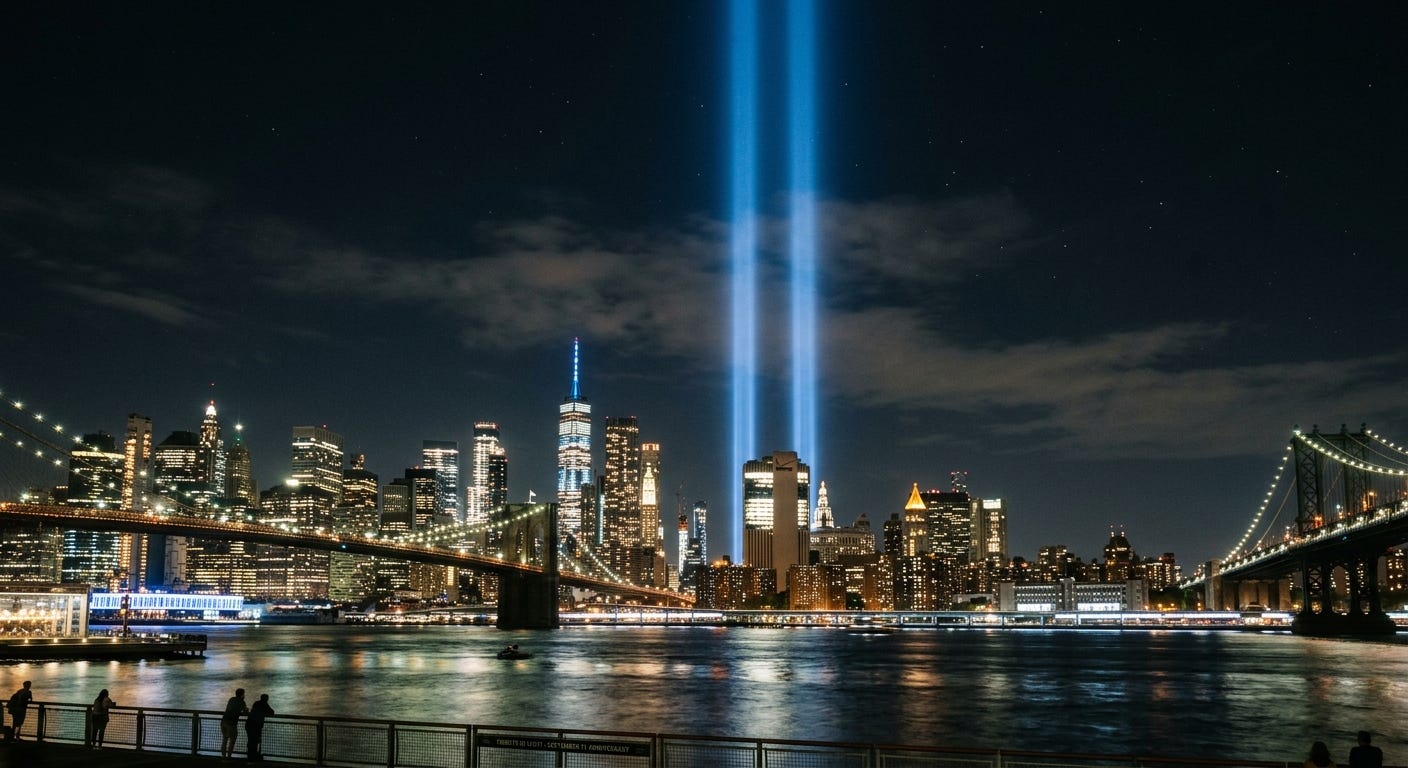
Every year, as the anniversary comes around, the conspiracy theories come back. This year they arrived with AI-assisted production. Now, videos generated in response to prompts show the towers from angles where no camera existed at the time. They show slow-motion footage that no real camera recorded. Some of these productions are so good that people who have never doubted anything are forwarding it to me and asking what I make of it.
What I make of it is that the technology has changed but the argument has not. A generated video is not evidence of anything except that somebody typed a prompt with intent. These videos cannot tell you what happens to structural steel at eight hundred degrees. What they can do is make a claim feel like a memory, and that is a new problem attached to an old claim.
I have my own reasons for not crossing into the conspiracy camp, and they are tied to my career and geographic location, not to patriotism or sentimentality. A few years after the terrorist attack, I moved to San Diego. The nature of my work put me close enough to fragments of the investigation to know what the raw material of this story actually looked like, and it did not resemble a well-planned plot. Rather, it looked like a mess.
Two of the men who died on American Airlines Flight 77, Nawaf al-Hazmi and Khalid al-Mihdhar, landed at Los Angeles International Airport in January 2000 and settled in San Diego. They rented an apartment in Clairemont. Hazmi opened a bank account in his real name. In the spring of 2000, the two of them went to Montgomery Field, on Aero Drive in San Diego, and took flying lessons at Sorbi’s Flying Club. They were terrible at it. The 9/11 Commission Report is blunt about their performance. They wanted to fly jets, yet they took no interest in takeoffs or landings; their English was too weak to absorb instruction, and by the end of May they had quit the classes. Neither of these two was at the controls of an airplane on 9/11; instead, they were assigned to be the muscle in the hostile hijacking. Hani Hanjour, who had trained in Arizona, flew the aircraft into the Pentagon.
Anwar al-Awlaki was the imam at Masjid Ar-Ribat al-Islami in San Diego from 1996 until 2000; the two of them attended his mosque. The Commission examined that relationship and, in the end, wrote that it could not determine the nature of their relationship. With the spotlight of the US Intelligence Community on him, Awlaki left the United States and resurfaced in Yemen in 2004. On 30 September 2011, he was killed by an American drone in Jawf province, the first American citizen deliberately targeted and killed by his own government. If you want something from the past twenty-five years to chew on, that is a stronger candidate than a controlled demolition.
That is the texture of the thing up close. Men who could not learn English well enough to fly a Cessna. Men using their real names on lease agreements and bank forms. A car left in an airport parking lot with documents inside it. The conspiracy that is being floated around requires thousands of people to execute a technically flawless operation and then hold their silence for a quarter of a century. The documented record describes the opposite kind of institution, one that lacked coordination and communication. The CIA knew in January 2000 that Mihdhar held a valid American visa and did not pass the name to the FBI until August 2001, when he was already inside the country. That is not the signature of an organization capable of secretly wiring three towers for a demolition on that day.
I do have questions, but my questions are different. I would still like a full answer on why that name sat unshared for eighteen months and on who exactly Omar al-Bayoumi was and who was paying him when he helped two Saudi nationals settle in my city. Those questions are about negligence and about Saudi conduct. They are not about explosives in a basement, and unlike the other kind of question, they have answers that can in principle be produced.
What nobody disputes is the damage, in human lives, in numbers. On a single morning, two thousand nine hundred and seventy-seven people died. Three hundred and forty-three New York firefighters went up the stairs while everybody else was coming down, and they did not come back. Out of that morning came at least two wars, a surveillance architecture that is now simply a fact of modern life, a permanent change to how every human being on earth boards an aircraft, and twenty-five years of rearrangement in my own part of the world, most of it paid for by people who had never heard of lower Manhattan.
Fidelity to the dead is a matter of precision, not feeling. The families of those firefighters have spent a quarter of a century receiving gray and shady narratives. What they are owed is the plain record, corrected where it is wrong and completed where it is thin. A story that turns that morning into a special effect, however professionally rendered, takes something from them that the fire already took once.