
In early April 2026, Donald Trump made a striking allegation during a Fox News interview: the United States had sent weapons to Iraqi Kurds to pass along to Iranian protesters, but the Kurds, he claimed, had kept them. Casual and unverified, the remark landed like a proverbial bomb in the Kurdistan Region of Iraq, igniting an inter-party crisis that exposed the fault lines running just beneath the region’s political surface.
What Was Said and What Wasn’t?
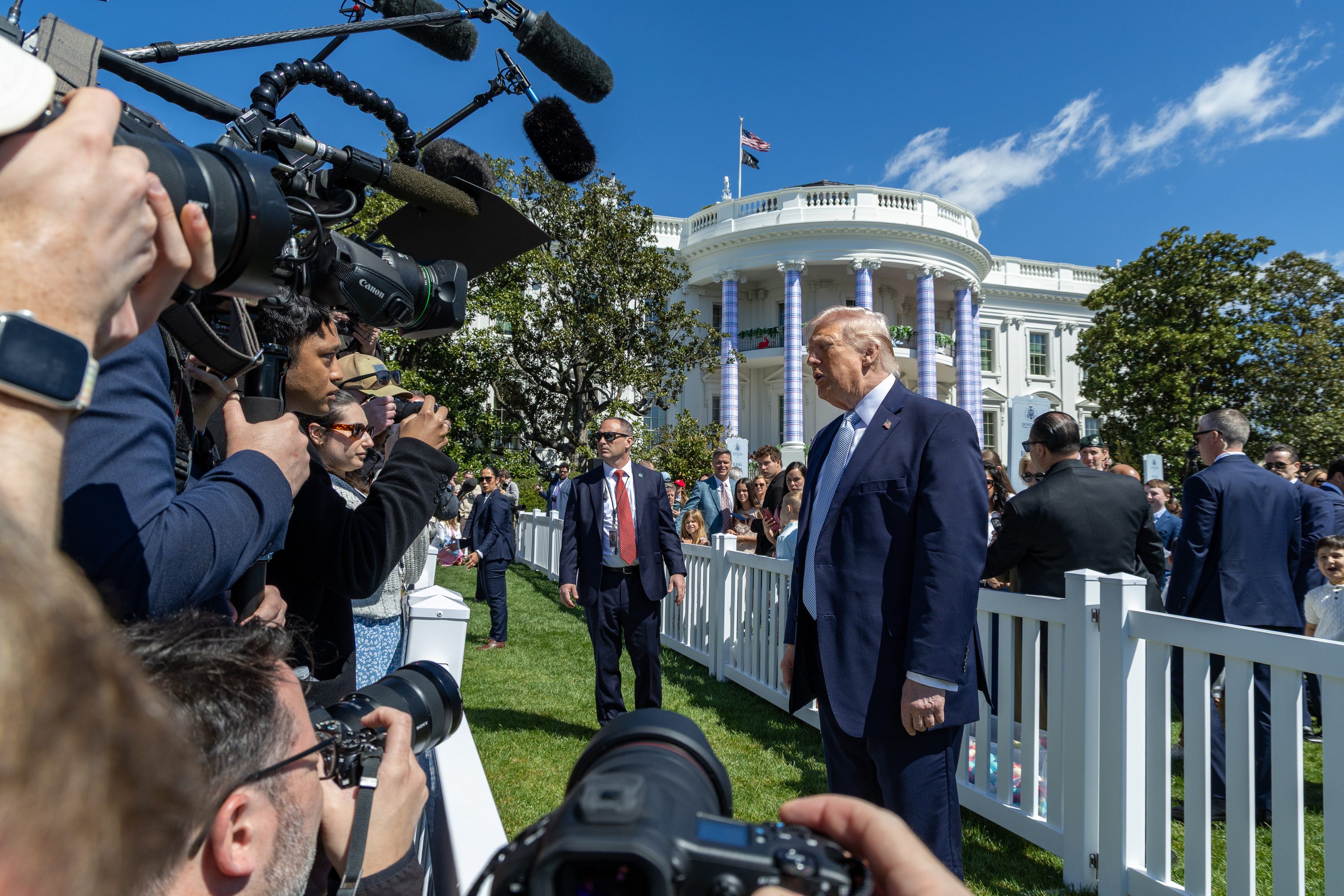
Calling Trump’s statement an “admission” is itself contested ground. Fox News’ Trey Yingst reported the allegation after a phone call with the president but shared no recording, and Trump himself, on tape at the White House Easter Egg Roll, referred only to “a certain group of people” keeping the guns, without naming the Kurds directly. Whether this statement constitutes a genuine disclosure of a covert operation, an exaggeration, or a deliberate manipulation remains an open question. More accurately, it was an unverified claim, relayed second-hand, never officially confirmed, and disputed by every party it indirectly implicated.
What the statement alleged was blunt enough: “We sent guns to the protesters, a lot of them. We sent them through a group. And I think the group took the guns.” Secretary of State Marco Rubio, when pressed by a Kurdish reporter, retreated into vague language about “symbolic support for Iranians,” carefully avoiding any confirmation of an actual arms transfer. Iranian Kurdish opposition groups across the board denied receiving anything.
The statement should not be seen as a policy disclosure but as political communication performance working on several levels at once, one of which may have been a calculated, if counterproductive, attempt to manage the Kurdish exposure to the ongoing regional conflict.
Trump had been pulling back from Kurdish entanglement well before the Fox interview. He had drawn a visible line between US military objectives and Kurdish ambitions, framing the Kurds as outside the scope of American commitments. As recently as March, he had explicitly told Kurdish leaders not to enter the war and walked back earlier enthusiasm for a Kurdish offensive into Iran. Blaming them for a failed weapons handoff, rather than crediting them with active participation, could, in that context, serve to lower their profile, giving Tehran less grounds to escalate strikes against Iranian Kurdish bases in northern Iraq.
The irony is that the statement achieved exactly the opposite effect. Kurdish leaders warned immediately that the claim could invite Iranian retaliation, and Tehran wasted no time using it to reinforce its narrative that the protests had been foreign-backed, a justification it had already deployed for mass arrests, executions, and cross-border strikes on Kurdish opposition bases. By publicly linking Kurdish groups to a US covert arms operation, however dubiously, Trump handed Tehran a propaganda tool that landed with real consequences on the ground.
The other motives layered into the statement are more familiar. For his domestic base, it cast the US as a covert actor boldly arming Iran’s internal opposition while simultaneously painting Kurdish allies as opportunistic and unreliable, a framing consistent with Trump’s longstanding skepticism of foreign partners. Shifting blame to the Kurds also insulated the administration from accountability regardless of whether any operation had actually taken place.
In the Kurdistan Region of Iraq, the statement did not register as abstract geopolitics; it widened the pre-existing fault lines. The KDP and PUK, the region’s two dominant parties, historically rivalrous, immediately turned on each other, each accusing the other of having received and withheld the weapons. The cycle escalated to the point that another Kurdish reporter directly confronted Trump to ask whether the weapons were being held in Sulaymaniyah, PUK territory. Trump remained silent, just as Rubio had remained silent with a different reporter. The silence on both ends fed the speculation rather than settling it.
For KDP supporters, the story implied that the PUK, with its alleged closer ties to Iran and its geography near the Iranian Kurdish opposition bases, had received weapons and concealed them. For PUK supporters, the denial of their party president was evidence of innocence and proof that the KDP was trying to score political points by blaming others. Neither side showed much interest in the underlying question of whether Trump was telling the truth. The statement had become a mirror, reflecting existing suspicions back at whoever was looking.
The episode fits a recognizable KRI pattern: external statements, particularly from Washington, get rapidly domesticated into the KDP-PUK frame, stripped of their original context, and repurposed in the ongoing competition for regional legitimacy.
Trump’s April 2026 weapons claim is most honestly characterized as a manipulative statement built on overlapping motives, base-rallying, pressure on Tehran, distancing the Kurds from direct entanglement, and headline-grabbing, with little verifiable substance underpinning any of them. What it was, most plainly, was an unverified allegation deployed for political effect, with the Kurds absorbing the cost. In the KRI, it was consumed by partisan media outlets, magnified beyond the intentions of Trump. In essence, it functioned as an accelerant poured onto already-smoldering inter-party tensions, turning an ambiguous American boast into another chapter in the long KDP-PUK rivalry.
The lesson here, especially for Kurdish media patrons and managers, is that political communication is a double-edged sword; handle it carefully. The weapons story faded in Western media within days. In KRI, the accusations it stirred took considerably longer to settle, and that asymmetry, between how briefly a statement registers in Washington and how long it echoes elsewhere, is its own lesson in how American political theater travels.