
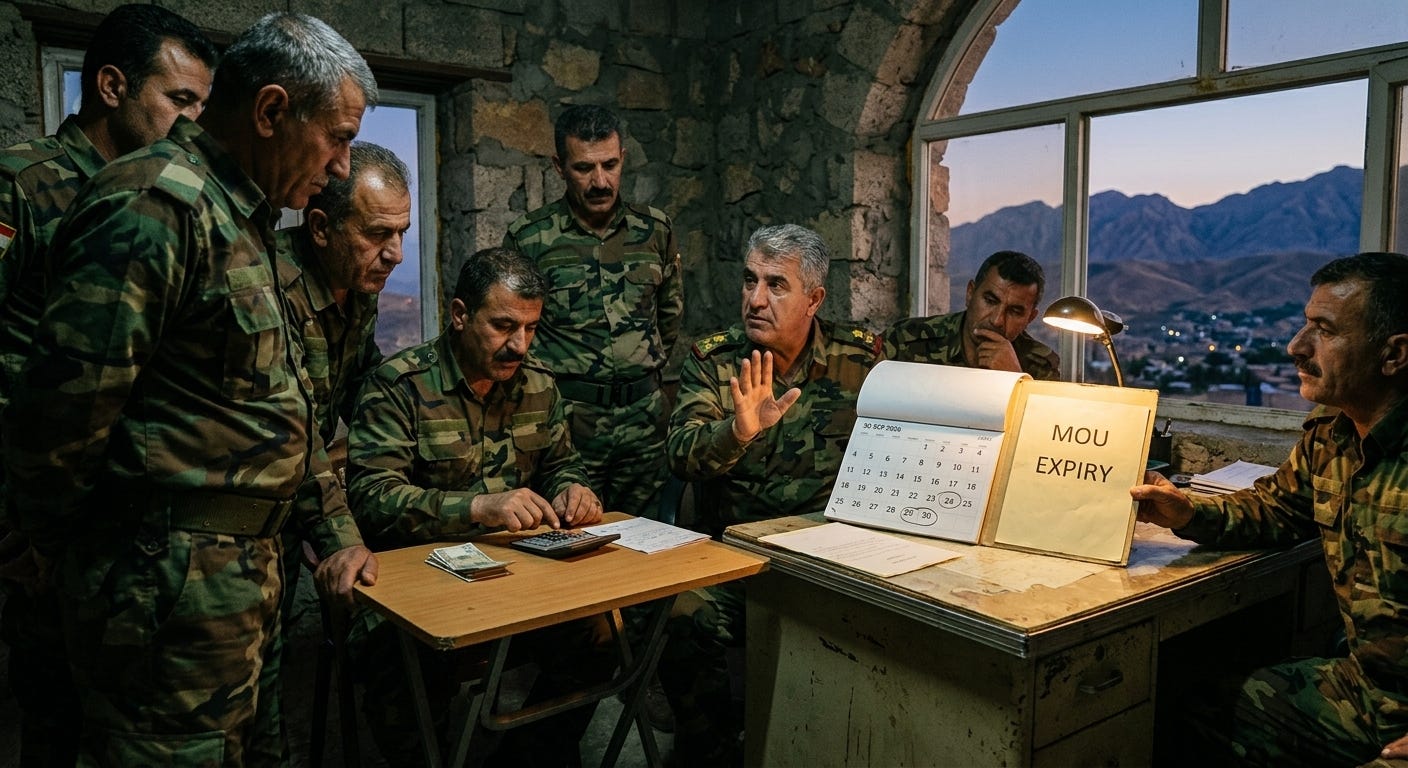
The BBC reported on 28 August that the Trump administration has told Erbil it will not renew the Pentagon’s memorandum of understanding with the Kurdistan Regional Government (KRG) when it lapses on 30 September and that the FY2027 budget request removes the $61 million line that paid for counter-ISIS support to the Peshmerga. Within hours the story had acquired the shape it will probably keep, fueled mostly by the local media frenzy based on BBC’s narratives of abandonment, a friend being discarded, and another Kurdish betrayal to be filed alongside the others. I have watched that reflex form since my first days at the prime minister’s office in 1993, and I understand where it comes from. But it is wrong here, and the reason it is wrong is more important than the attempt to offer correction.
Let me start with the simplest fact. Nobody who is in a position to know is surprised, and if they act surprised, then it is just an act.
On 14 May of this year, Staff Lieutenant General Bakhtiar Mohammed Sidiq, the secretary general of the Ministry of Peshmerga Affairs, sat for an interview and said plainly that the memorandum expires in September 2026 and that any successor “will not be renewed in its current bilateral form.” He went further and said the region needed to begin considering how to replace the support, financial, material, and advisory. That is the ministry’s own senior officer describing, three and a half months in advance, the outcome that has now been presented as a bolt from Washington. If KRG’s own Ministry of Peshmerga knew, then Washington is not the one who caused the surprise.
Salary support through the Counter-ISIS Train and Equip Fund paid roughly $135 million in 2024, $60 million in 2025, and nothing in 2026. The zeroing of Peshmerga stipends appeared in the FY2026 budget documents and was reported in August of last year. A policy that shows up in published budget justifications a full year before it takes effect is not a secret. It is a notice of action.
The memorandum was signed on 21 September 2022 by the Minister Shoresh Ismail and Celeste Wallander of the US Department of Defense, and it ran for four years. A fixed-term agreement reaching its end date is a different act from a revocation, and the distinction is not pedantry. Revocation implies a judgment rendered mid-course, while expiry implies a clock that everyone could hear ticking.
The memorandum was also never a subsidy; it was a bargain. Washington paid, and in return the Kurdistan Region undertook to fold Unit 70 and Unit 80, the PUK and KDP formations, into a single force answerable to the Ministry of Peshmerga Affairs (MoPA) rather than to two party headquarters. Four years was the timetable, and September 2026 was the finish line. The unification was not completed. Area Command One, built from Unit 80 of KDP, was established with its divisions across Erbil and Duhok. Area Command Two, to be formed out of Unit 70 of the PUK, remains incomplete, and General Sidiq described the obstacles as technical and partly political, which is the polite formulation for the real one. The same interview put actual manpower at between 150,000 and 155,000 against an agreed ceiling of 138,000, which tells you how much of the reform had been arithmetic on paper.
A study published by iNNOV8 Research Center in May of this year made the sharpest version of the point. The sequencing was inverted. Command unification was treated as the opening move when it should have been the closing one. A unified command sitting on top of fragmented financial systems, party-loyal officers, and separate logistics chains, as the paper analyzed, is not a unified command in any operationally meaningful sense. Financial consolidation and depoliticization had to come first for the process to succeed, and the paper backs the claim with evidence.
This is the part I would ask readers to sit with, because a claim of betrayal requires one party to have kept its side. Conditional assistance is a contract between a patron and a client who has veto players of his own, and it works only when those veto players want it to work. Two parties that regard armed formations as the guarantee of their own survival were never going to surrender them in exchange for an annual funds transfer, however welcome that transfer was. This is not a failure by Americans. It is a structural fact about the way our politics is organized, and it produced precisely the outcome the structure predicts.
It is worth noting as well that the cut is not aimed at Kurds specifically. Total counter-ISIS training and equipment support to Iraq falls in the same request from about $175 million to about $96 million. The Peshmerga line sits inside a general drawdown that follows the September 2024 understanding between Washington and Baghdad to wind down the coalition mission. We are one column in a budgetary spreadsheet, and that column is shrinking in every direction.
The critics have a real point, and it should be met rather than dodged. A gradual decline in support is not the same thing as a zero, and going to zero in FY2027 is a step change, not the continuation of a trend. Nothing about an expiry compels a government to strike the line rather than renegotiate the terms. Washington could have written a shorter, tighter, more conditional successor. The timing carries its own weight too; although no one predicted what September 30, 2026, would look like, the arrival after a year in which the region absorbed Iranian strikes and the case for capable local defense was not exactly abstract.
I would rather we spent the coming month on the question that is actually more pressing: the tenth cabinet still has not been formed. Parliament was elected in October 2024, its members were sworn in that December, and we are now in the second half of 2026 with no government, no settled speaker, and none of the political authority that unifying an army requires. Unit 70 and Unit 80 were never going to merge inside that administrative vacuum. The memorandum did not fail because Washington lost interest; it ran out of time in a place where nothing has been asked to finish.
We, Kurds, have a habit of reading the world as a sequence of things done to us. Sometimes that reading is accurate, and our history offers no shortage of material for it. But it is a comfortable story, and that comfort is what makes it dangerous, because it places the explanation outside the room where nobody present has to act on it. The version that costs something is simpler. We were given four years and a condition; we took the four years and hoped the condition would go away.
