
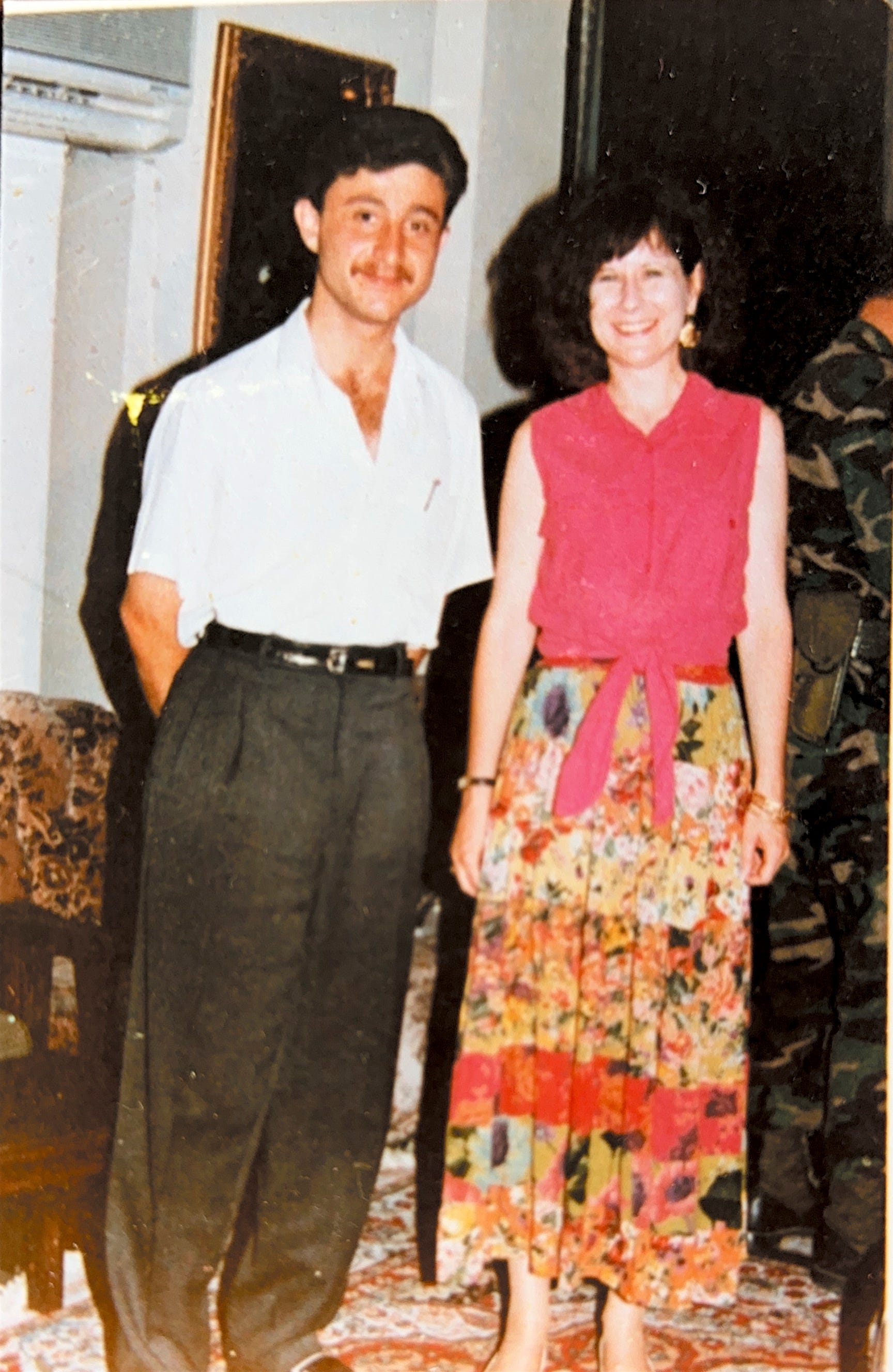
I came across this photograph recently; I had not looked at it in many years. Here I am standing next to Susan McCormick Pond at the residence of Jalal Talabani in Erbil. I cannot date it more precisely than sometime between 1994 and 1996, which in the Kurdistan of those years covers a great deal of history. I was working then as an interpreter for the Prime Minister, Kosrat Rasul Ali, and Susan was a familiar face. We knew her as the political advisor to the Military Coordination Center in Zakho, and she also turned up with State Department delegations when they came through.
The MCC was the small allied post set up in 1991 under Operation Provide Comfort, after the uprising collapsed and more than a million Kurds fled into the mountains along the Turkish and Iranian borders. For years MCC was the closest thing Washington had to a presence on the ground in all of Iraq. There had been no American embassy in Baghdad since the invasion of Kuwait, and our dealings with the US government ran through the State Department and the CIA. Our joint agenda was defined and limited. Keep watch on Iraqi military movements around the 36th parallel, the line above which Allied aircraft kept Baghdad’s planes out of the sky, exhaust the Iraqi army, and wait, with more hope than evidence, for a coup that would remove Saddam from inside his regime.
Among those of us who worked with the Americans, there was a piece of trivia about Susan that we passed around half in disbelief. It was said that she kept a photograph of Saddam Hussein hanging in her office at the State Department. When we finally raised it with her, she confirmed it. Her explanation was simple. She recognized Saddam as a strongman, and the picture had nothing to do with any affection or admiration for him.
At the time I could not make sense of it. Halabja and the Anfal campaigns were only six or seven years behind us. Saddam’s army sat a short distance from Erbil, and the whole point of our relationship with Washington, as we understood it, was to see him gone. Yet here was an American official, one of the people we were counting on, with Saddam’s face on her wall in the building where Iraq policy was made.
I understand it better now than I did then. Realists have long argued that states deal in power as they find it, not as they wish it to be, and that the statesman’s first duty is to see the other side clearly. A portrait on the wall is one way to do that. It is a reminder of who you are dealing with: a man who had survived eight years of war with Iran, a catastrophic defeat in Kuwait, and uprisings in the north and south at once, and who was still sitting in Baghdad. Respect for durability is not the same thing as approval, and Susan was drawing exactly that line when she answered us.
There was also a longer history behind the picture that we tended to forget. In the 1980s Washington had taken Iraq off its list of state sponsors of terrorism and restored diplomatic relations in 1984, while the war with Iran was still running. The man in that portrait had been a partner of convenience before he became a target. For American policymakers, recognizing Saddam was a professional habit long before it became a puzzle for a Kurdish interpreter in Erbil.
Looking back, the same logic governed how Washington treated us. We were supported because we were useful against a strongman, and the limits of that support were set by American calculations about the region, not by any sentiment about the Kurds. The anticipated coup never came, and at the end of August 1996, in the middle of our own civil war, Iraqi forces entered Erbil. Within months the MCC was gone, and Operation Provide Comfort wound down at the end of that year. Saddam stayed in power until 2003, and in the end he was removed by invasion rather than from within.
There is an irony in where this photograph was taken. The house belonged to Mam Jalal, then secretary general of the PUK, who in 2005 became the first Kurdish president of Iraq. Saddam was tried and executed during his presidency, and Talabani, a lawyer who was a lifelong opponent of the death penalty, declined to sign the order himself. He died in October 2017, nine years ago this month.
I look at the two of us in that picture and think about how differently we were reading the same situation. I saw a dictator who had to fall. She saw a strongman who had to be understood. Both of us were right, and it took me most of the following thirty years to appreciate that the second view was not a betrayal of the first.