
The sky over Erbil was once defined by its stillness, the occasional landing of a passenger airliner, or the buzz of Coalition helicopters overhead, yet all was peaceful. Today, that same sky has turned into a source of involuntary vigilance. For the residents of the Kurdistan Region of Iraq (KRI), looking up is no longer an act of connecting with nature; it has become a natural defensive reflex. We are living through a period where the unprecedented has transitioned into a daily routine, and in that shift lies a quiet, damaging danger to the fabric of our society. The drones that hum above our neighborhoods are not just tactical weapons of high significance; they are machines of psychological degradation that are redefining the meaning of feeling secure in one’s own home.
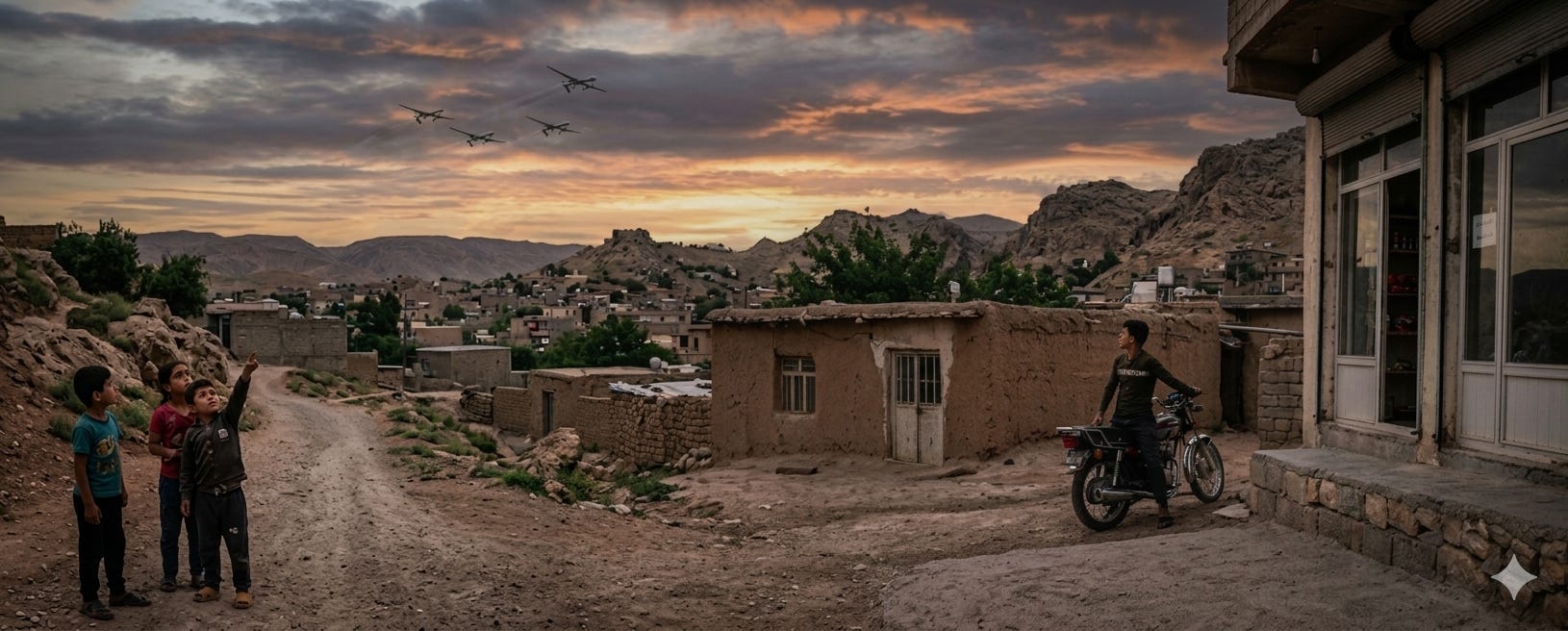
In the global conflict landscape, the use of drones has become a hallmark of modern warfare, begging for comparison to conflict zones like Ukraine. However, a crucial distinction must be made to understand the specific weight of the situation in the KRI. In Kyiv or Kharkiv, when sirens wail, they signal a threat to a population that is already in a state of war and is fully mobilized. Ukraine is a party to an existential war; its citizens, while suffering immensely, are operating within a framework of national defense and recognized conflict, albeit being involuntary. KRI, by contrast, is not a party to the ongoing war between the US and Israel on one side and Iran on the other. Yet, its residents are forced to endure the trauma of an active war zone atmosphere. Essentially, KRI has been turned into an involuntary frontline—a civilian population caught in the crossfire of a regional shadow war.
This unique situation creates a profound sense of disharmony. There is a specific acoustic signature to life in Erbil right now. It begins with the low, mechanical drone—a sound that vibrates in the ears and creates bodily chaos. Then comes the response: the unworldly, rupturing staccato of the C-RAM systems or the blindingly fast streak of interceptor projectiles. Finally, there is a blast, which might be the dull thud of a successful interception or the bone-shaking explosion of an impact. For a few seconds, the city holds its collective breath. And then, the most surreal part of the experience begins: life simply resumes.
This is often called resilience, but that term is becoming increasingly insufficient. There is a fine line between resilience and an involuntary curbing of the human spirit. When a society begins to treat the sound of incoming munitions as background noise, it isn’t necessarily because they are brave; it is because the human nervous system cannot sustain a state of red alert, a status of fight or flight, indefinitely. People are training themselves to live in a permanent state of high alert, effectively normalizing a level of threat that would be considered an international crisis anywhere else in the world. This braced state is exhausting, and it drains the creative and social energy of a city, replacing long-term aspirations with short-term survival instincts.
Traditionally, conflict happened on fronts, battlefronts. But the drone ignores the walls of our houses and the gates of our residential complexes. Social media in the KRI is peppered with footage of living rooms showered in plaster, gardens littered with twisted burnt metal, and the jagged remains of interceptors that failed upward only to rain down on the roofs of sleeping families. When the ceiling of your home is no longer a protector against external violence, the fundamental concept of urban safety is shattered. This transforms the home from a sanctuary into a place of vulnerability.
The generational impact of this environment is that we will accumulate the greatest debt. We are currently raising a generation of children who can distinguish between the hum of a motorcycle and the motor of a suicide drone even before they have learned a second language. This is a skill no child should possess. Children are like sponges absorbing the atmospheric tension of their parents; they see the quick, silent glance toward the window when a loud car backfires. They learn that safety is conditional and that the sky is a source of potential threat. By normalizing this for them, we risk creating a generation that prioritizes uncertainty over trust and survival over curiosity. This toxic stress doesn’t just result in negative memories; it shapes the way a developing mind perceives the world’s reliability.
Ultimately, we must resist the urge to frame these attacks as mere security incidents or geopolitical ripples. To do so is to concede that civilian life in the KRI is inherently less deserving of peace than life in any other place. The comparison to Ukraine serves to highlight the unique grievance of the Kurdistani people: KRI is enduring the symptoms of a war without being a participant in the fight.
As we go about our daily lives—drinking our teas and coffees, going to work, or walking in our parks—we must acknowledge that resilience should not be a justification for the continued presence of the abnormal. We owe it to ourselves, and specifically to our children, to remember what a quiet sky actually feels like and to refuse the idea that living on edge is simply the price of residing in this part of the world
.