
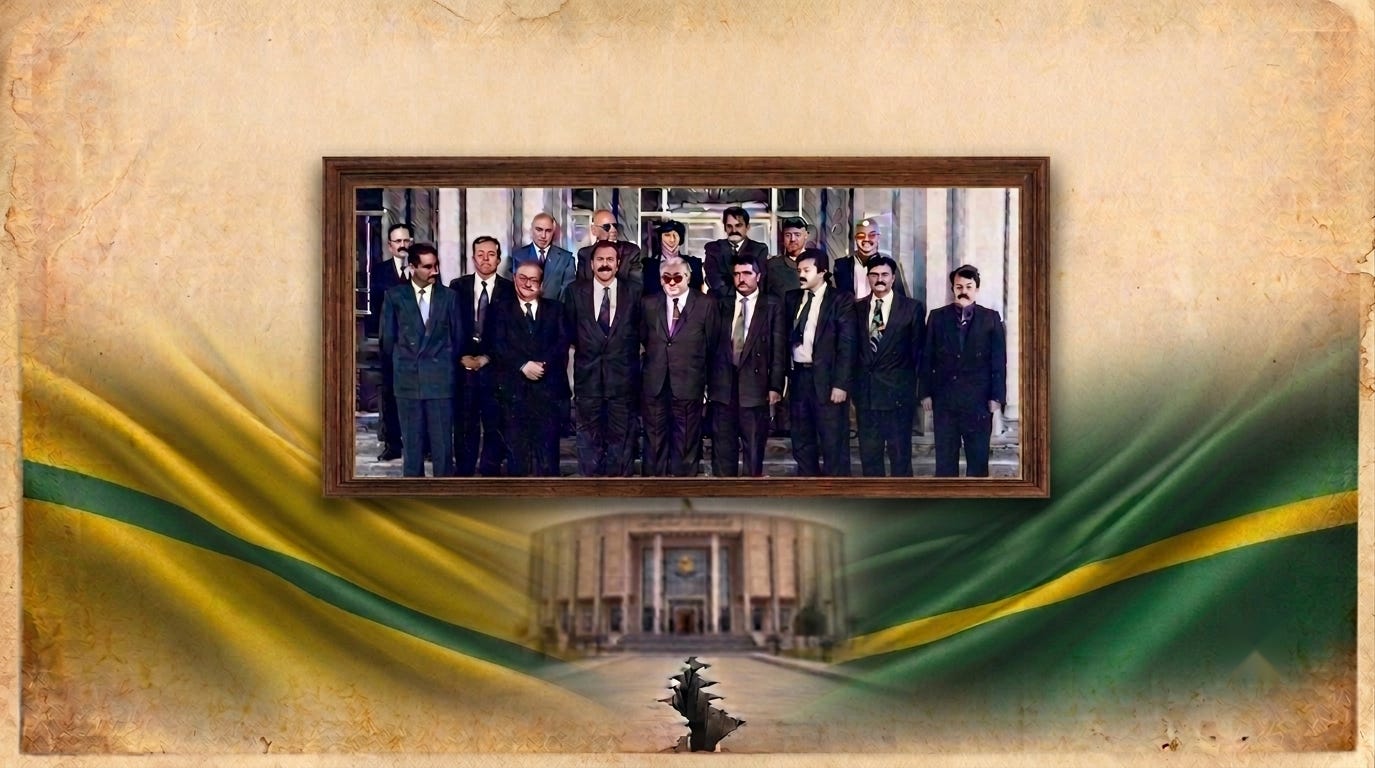
Thirty-four years ago this week, on the fourth of July 1992, a group of men stood in a modest hall in Erbil and swore an oath to govern a region that, on paper, did not exist. There was no state behind them; Baghdad had withdrawn its administration and sealed the roads south. The UN embargo on Iraq applied to us too, so we were blockaded twice over, once by the international community and once by the capital of the state that we lived in. The ministries these men were about to lead had no budgets and, in some cases, no buildings to operate from. What they had was a mandate from an election held six weeks earlier, in which people who had survived the Anfal and Halabja campaigns and the exodus of 1991 walked to polling stations and dipped their fingers in ink as if it were the most natural and patriotic thing in the world to do.
The following year I joined the prime minister’s office under the second cabinet, young and convinced, like everyone around me, that we were building something permanent. I remember salaries paid in Iraqi dinars so devalued that we counted them by the brick rather than by the note. I remember ministers sharing cars. And I remember the strange, hopeful machinery of the arrangement that made the whole thing possible: the 50/50 system.
It is worth recalling how it came about, because the details of that arrangement have softened with time. The election of 19 May 1992 gave the Kurdistan Democratic Party (KDP) a narrow lead over the Patriotic Union of Kurdistan (PUK). Each side accused the other of election fraud. In most places on earth, in that era and in ours, a disputed election between two armed parties can only end in one way. But not for us, at least not exactly then. The KDP conceded a seat so that both parties held fifty each, and they built a government on that symmetry. Every ministry went to one party with a deputy from the other. Every decision, in theory, was made twice. It was inefficient, duplicative, and occasionally comical. It was also, given where we had just come from, close to miraculous. Two movements that had spent parts of the previous decades fighting each other, in addition to fighting the Baath regime, in the mountains chose, at the moment of maximum uncertainty, to share rather than to win.
I have been thinking about that choice constantly these past months because we are now twenty months past the election of October 2024 and the tenth cabinet still does not exist. The parliament elected that autumn has convened to swear in its members and little else; in theory, the first session remains open. The KDP won 39 seats to the PUK’s 23, and the two parties have spent nearly two years arguing over what those numbers should mean. The PUK insists on what it calls an effective partnership, which in practice means something close to the old parity: real shares of the sovereign ministries and joint control of the levers of governance that matter. The KDP points at the arithmetic and asks why a party with barely more than half its seats should govern as an equal. The dispute has run through the interior ministry, through the question of a unified candidate for the Iraqi presidency, and lately through the PUK’s open flirtation with forming a government alongside the New Generation Movement and leaving the KDP out altogether, a proposal that would have been unthinkable to the men of 1992 and is spoken of casually now.
So the question I want to ask, as someone who served in one of those early cabinets and has spent the decades since watching from progressively greater distances, is an uncomfortable one. Is the deadlock of 2026 the child of the compromise of 1992?
Political scientists have a name for what we built back then, though nobody in Kurdistan was reading Arend Lijphart at the time. They call it “consociationalism”: government by grand coalition, proportional shares, and mutual vetoes. It is the standard prescription for divided societies, and it has a decent record of stopping wars. However, it has a much poorer record of ever ending. Lebanon fixed its ratio of parliamentary seats to a census taken in 1932 and then declined, for decades, to count its people again because everyone understood that the formula could not survive contact with reality. Bosnia froze the battle lines of 1995 into a constitution, and thirty years later a country of three million people maintains three presidents. The pattern is consistent enough to be a rule. Power-sharing deals are written as emergency measures, and emergency measures never include their own expiry date. The parties that benefit from the formula develop an interest in the formula, not in the state it was meant to produce.
Kurdistan followed the script with dispiriting fidelity. The fifty-fifty government of 1992 could not survive its own contradictions, and by 1994 the two parties were at war with each other. By 1996 there were two administrations, one in Erbil and one in Sulaymaniyah, each with its cabinet, its own revenues, and its own armed forces. The Washington Agreement of 1998 stopped the fighting, and the administrations were formally reunified in 2006, but the reunification was itself another fifty-fifty in spirit: the strategic agreement of 2007 divided posts, revenues, and commands between the parties rather than surrendering them to institutions. What never happened, in all those years, was the thing that would have let the formula retire gracefully; the peshmerga were never fully unified, the party payrolls never merged into a neutral civil service, and the ministries remained, beneath the letterhead, party property. And so, losing an election never became safe; that is the heart of this dilemma. In a normal system the losing party goes into opposition and waits, protected by institutions it trusts. Here, a party that surrenders its share of government metaphorically surrenders its shield. Nobody disarms first. Economists call this a commitment problem, and it explains our politics better than any theory of ideology or personality.
Seen this way, the deadlock is not a betrayal of the 1992 arrangement but its inheritance. The fifty-fifty taught us that governments in Kurdistan are formed between parties, not within parliaments. Elections here have never really decided who governs; they decide the opening bids of a negotiation conducted elsewhere between two organizations that each keep their own forces and their own geography. Every cabinet since the first has been a treaty wearing the costume of a government. The tenth cabinet is late because the treaty has become harder to write, not because the costume size or design has changed.
And yet I cannot bring myself to say the PUK is simply wrong to resist majority rule, however much the numbers favor the KDP. Thirty-nine to twenty-three is not parity, and pretending otherwise insults the voters. But majoritarianism assumes the institutions of a state, and we have not built them. Handing unified control of interior, finance, and the security file to a single party, in a region where the other party still commands its own forces, is not democracy; it is asking one side to trust what has never once been trustworthy. The honest answer to whether it is reasonable to expect fifty-fifty in 2026 is no. The equally honest answer to whether it is reasonable to expect the PUK to accept its abolition, with nothing built in its place, is also no. That is what a thirty-four-year-old temporary measure looks like when it comes due.
The way out is not a cleverer ratio; it is the slow, unglamorous work that both parties have postponed since I was a young man in the prime minister’s office: a peshmerga answerable to the ministry rather than the politburo, revenues published rather than partitioned, and a civil service that survives elections. Make losing safe, and the formula can finally die of natural causes. Refuse, and we will renegotiate the treaty every four years while generations that have never seen a government formed on time conclude that voting is nothing but a theatrical performance.
What moves me about the fourth of July 1992 is not the fifty-fifty system itself. The formula was a crutch, and everyone knew it and worked back then. What moves me is that two rivals, fresh from betrayal and war, decided that the region mattered more than the ratio and took an oath together in a hall with no money and no guarantees. Their successors, some of them sons of the same people who inherited the seats, dispute a far smaller gap in a far richer Kurdistan, and have so far found the distance uncrossable. The ratio was always negotiable. The willingness was the miracle. It is the only part of 1992 worth restoring exactly as it was.