
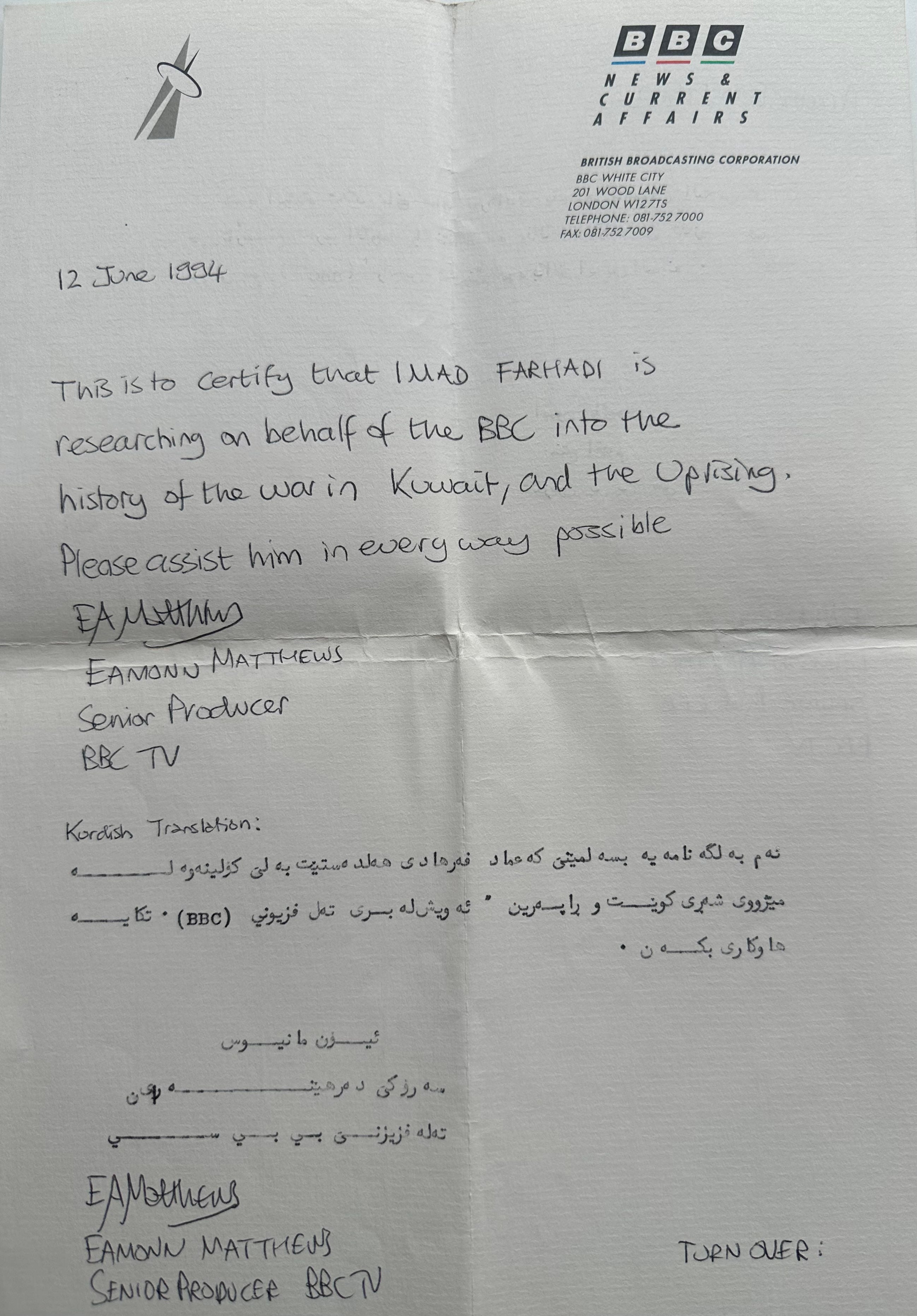
Going through old papers recently, I came across a few folded sheets on BBC letterhead. The first is dated 12 June 1994. It is a handwritten brief from Eamonn Matthews, then a senior producer with BBC News and Current Affairs in London, and it came with a letter of accreditation certifying that I was “researching on behalf of the BBC into the history of the war in Kuwait and the Uprising” and asking anyone who sees the letter to “assist him in every way possible.” Kurdish and Arabic translations were added underneath, so the letter could do its work at a checkpoint or in a village on either side of the line.
The brief leaves no doubt about what he wanted to be researched. “Please find ordinary people with extraordinary stories to tell,” it begins, “the most horrific, the most intense: the stories you will want to tell your friends.” I was to meet them, write each story in 150 words, and fax the batch to London by 18 July. He would ask Latif Rashid, then the PUK’s representative in Britain and, many years later, president of Iraq, to get me permission to use a fax machine. That one line says a lot about how cut off Kurdistan was from the rest of the world in 1994.
The list itself reads like a map of the previous four years. For the uprising, he wanted someone from Ranya, where the first shots of March 1991 were fired when security men tried to arrest deserters who had come home from Kuwait. He wanted a prisoner freed from the torture cells when the jails were thrown open, a man or a woman who had killed Baathist officials and was willing to explain why, and families who were attacked from helicopters as they fled to the mountains. He also asked for Shia from the south with similar stories. For Kuwait, he wanted Iraqi soldiers: special forces men who had stormed the Emir’s palace, conscripts who had sat under weeks of bombing and then faced American and British armor, survivors of the attack on the retreating columns at Mutla Ridge, and soldiers who went home humiliated to Basra, Najaf and Nasiriyah and started shooting. He wanted a pilot who had flown his jet to Iran and could say why, and a Scud crew who could describe how they kept ahead of the aircraft hunting them. “Concentrate first on the war in Kuwait,” he wrote, “that’s the most difficult.” Then, underlined: “Talk to people. Meet them. Travel to them. Forget politics.”
I was not paid in advance, and I did not expect to be. When Matthews left Erbil, I had a full assignment, with a deadline attached. At the time I was working as an interpreter for the Prime Minister, Kosrat Rasul Ali, and this assignment was something I took on alongside the day job because it was precisely the kind of work I was drawn to. Unfortunately, it never got past the agreement stage. The first round of fighting between the PUK and the KDP had broken out at the beginning of May, a few weeks before the letter was written, and over the following months the conflict intensified. The roads I would have needed to travel became front lines, and the people I would have needed to locate had other things to worry about. To my knowledge, Matthews never came back to Kurdistan to follow it up, and I never wrote the stories.
According to my recent follow-up, the project went ahead without me. In January 1996, The Gulf War aired on PBS Frontline as a co-production with the BBC, written and produced by Matthews. A companion BBC radio series built from the same research included one episode on Iraqi soldiers on the road to Basra and another on a family that fled to the mountains during the Kurdish uprising. Some of the people on his list did reach an audience in the end, found by someone else.
Reading those pages thirty-two years later, what stays with me is less the assignment than the appetite behind it. In 1994 we were barely four years past the invasion of Kuwait. Iraq was under the UN sanctions imposed in August 1990, and Kurdistan carried a double load because Baghdad had pulled its administration out of the region in late 1991 and put us under a blockade of its own. We had elected a parliament in May 1992 and were trying to run a government on almost nothing. With this backdrop, journalists came with an appetite to write.
They came for different reasons. Some followed the work of international NGOs that were rebuilding the villages Saddam’s army had flattened in the 1980s. Some came to record what the sanctions were doing to ordinary families in Kurdistan and in the rest of Iraq. Some were looking for the untold stories of Halabja and the Anfal, which much of the world had looked away from when they happened in 1988. And some, like Matthews, were after the politics and the human cost of two wars in one decade. Enough of them passed through our office that I learned to read them quickly.
Political scientists have a name for the pattern I was watching. In 1972 Anthony Downs described what he called the issue-attention cycle (IAC): a problem bursts into public view, draws a rush of concern, and then fades as people realise how hard it is to fix and their attention moves on. Kurdistan has gone around that cycle more times than anyone could count. The exodus of 1991 brought the cameras, and the pictures of civilians, the elderly, women, and children spread across snow-covered mountains did a significant deal to push Western governments into creating the “safe haven.” Then the cameras thinned out, came back when Iraqi tanks entered Erbil in 1996, left again, and returned in 2003, in 2014 when ISIS reached the edge of our cities, and in 2017 for the independence referendum. When the temperature here rises, politically or in terms of security, the coverage rises with it. When it cools, the reporters go home, and the slower stories of culture, economy, and institution building rarely make it onto anyone’s schedule.
Kurdistan has come a long way since a foreign producer had to arrange permission for me to send a fax. The interest from Western media has changed along with it, and so have the people who come. Some are hired pens, invited and looked after so that they show only the rosy parts. Some are hunters, here for a story that was half written before their plane landed and gone as soon as they have it. And some keep coming back. They cover the good, the bad, and the ugly; they are fair to everyone involved, and they are a large part of why Kurdish issues have not dropped out of sight between crises. I know several of them personally. I will not name them here, because they would rather have their work speak for them.
Matthews wanted the horrific and the astonishing, and in 1994 there was no shortage of either. But he also wrote “Forget politics,” and he wanted ordinary people. That is still the right instinct, and still the hardest thing for a visiting journalist to get right. The extraordinary stories here have always belonged to ordinary people. The ones worth telling now are not all horrific.
I kept the letters for no particular reason at the time. My own brushes with the media did not end there, and years later when I was in the US, I ended up reporting for the Kurdish service of the Voice of America. That is a story for another time.