
For most of the last century, military power was something you could count. Alongside the training of troops, which is itself a measure of strength, armies were measured by the number of their tanks, artillery, aircraft, warships, and ammunition. Those inventories mattered, which is why weaker opponents have always searched for ways to make an enemy’s numerical superiority less decisive, and that search is what we call asymmetric warfare, in which the weak exploit the blind spots of the strong instead of confronting them directly.
A drone carrying a conventional explosive warhead does not become an unconventional weapon simply because nobody is sitting inside it, so technically, drones have not made war unconventional. The change lies in how cheaply and widely that capability can now be fielded. Cheap drones, and to a lesser and still unproven degree cheap AI technology, have lowered the cost of the asymmetric option to the point where far more actors, including rogue states and substate groups, can afford it. The question worth asking is how far that goes and who is paying attention.
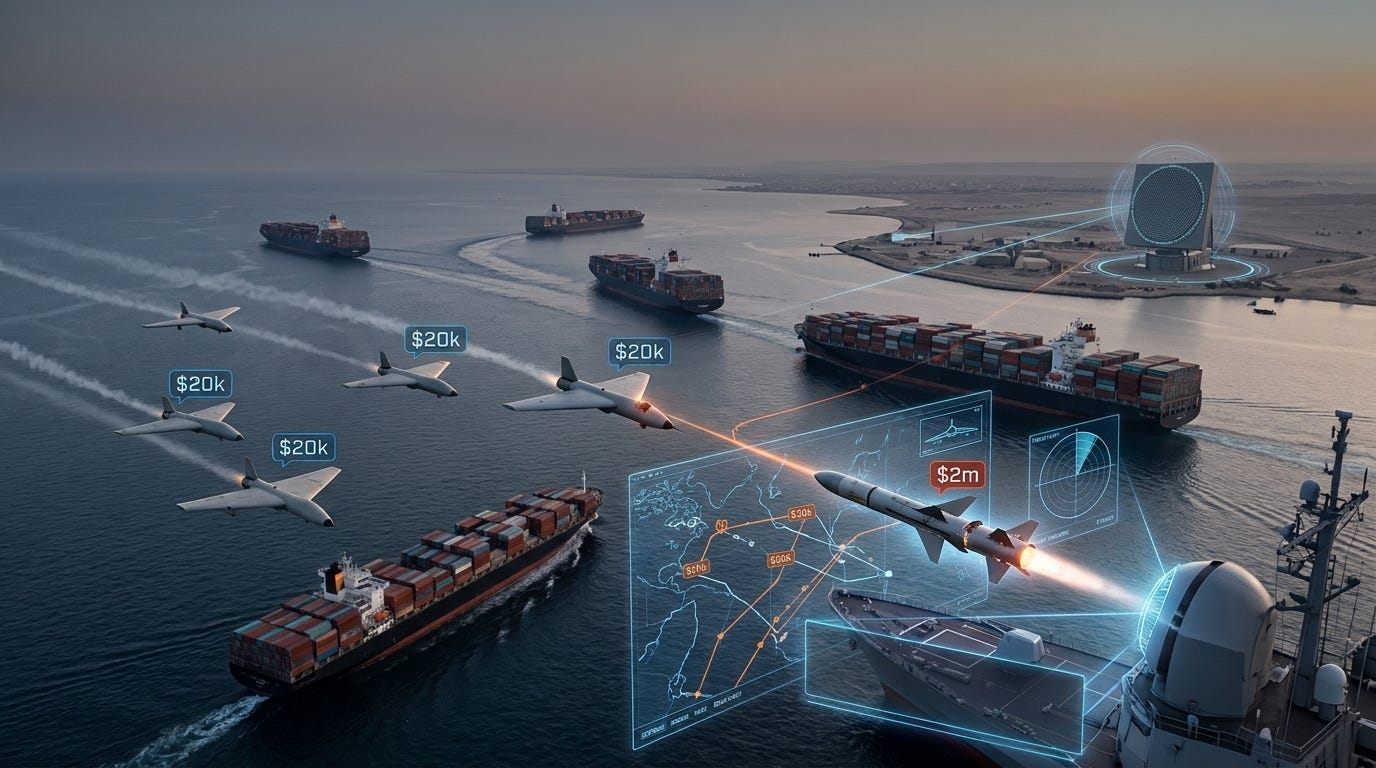
Simply put, a one-way attack drone of the Shahed type is estimated to cost in the tens of thousands of dollars, while some of the interceptors fired to stop it cost a million or more. When the Houthis began striking shipping in the Red Sea with drones and missiles in late 2023, the US Navy found itself spending interceptors worth far more than the weapons they destroyed. A movement with no air force succeeded in pushing global shipping away from the Suez route, and by January 2024 UNCTAD recorded a 67 percent fall in weekly container-ship transits through the canal, with freight rates climbing as a result.
To be fair, an expensive interception can still be a rational choice when it protects a ship and its crew, so the real strategic problem is whether defenders can replenish their costly interceptors as quickly as attackers can replenish cheap drones. Nor is it new that cheap weapons can impose expensive losses, as insurgents have done exactly that with roadside bombs for decades. What is new is how widely accessible long-range, relatively precise attack has become. Precision strike at a distance once required resources and infrastructure that few actors could afford, and it is now close to being a commodity.
In an earlier piece for The Kurdish Chronicle, “Abandon or Adapt,” I asked whether Iran could keep sustaining its proxies or would eventually have to let them go. The more recent events point toward adaptation, and drones are a large part of the reason.
The US and Israeli war on Iran between February and April, which killed Ali Khamenei, left Tehran badly shaken, and Hamas and Hezbollah are far weaker than they were three years ago. Yet the network has not collapsed but has instead shifted its weight toward the Houthis and the Iraqi militias. In the first days of the war, on March 1, the Islamic Resistance in Iraq claimed 23 drone attacks against bases in Iraq and the region, while Iranian-backed militias also claimed attacks on US forces stationed at the Erbil airport. On May 17, according to Emirati authorities, drones launched from Iraq targeted the UAE’s Barakah nuclear power plant, and one of them struck an electrical generator outside the plant’s inner perimeter, though no radioactive release was reported and a later multinational statement attributed the attack to armed factions in Iraq.
Then in September, the Associated Press reported that Houthi emissaries had helped Iraqi militias plan and execute a two-day drone attack on Saudi oil facilities in July. According to two Saudi officials and a senior Iraqi security official, the emissaries worked inside a militia-run operations room, although Popular Mobilization Forces officials denied any involvement.
Keeping alive a capacity for occasional long-range drone strikes is far cheaper than sustaining large forces of trained fighters and stockpiled rockets, and it can complicate attribution, even if the Saudi case shows that investigators can still trace the people and coordination behind an attack. Iran does not need to restore Hezbollah’s former strength to retain the ability to impose significant regional costs. It only needs to keep components, know-how, and a few IRGC advisers moving between Yemen and Iraq, which is a much lower bar.
There is a limit, though. The Houthis and the Iraqi militias still depend on a patron for parts and expertise, and the Houthi arsenal still relies on missiles and smuggled weapons alongside its drones. Cheap asymmetry, in other words, is not the same as independent asymmetry.
Western coverage of Ukraine tends to praise Kyiv’s drone innovation, and much of that praise is earned. Despite lacking a surface fleet capable of matching Russia’s, Ukraine combined sea drones with shore-based and long-range missiles to force much of Russia’s Black Sea Fleet away from Sevastopol, which is asymmetry in its classic form, achieved through a combination of tools rather than a single technological miracle.
The part that gets less attention is how quickly Russia adapted. It purchased Shaheds from Iran and then produced its own version at home, scaled up FPV production, built specialized drone units, invested heavily in electronic warfare, and fielded fiber-optic drones whose control links are resistant to radio-frequency jamming. The drone edge on the front has swung back and forth ever since.
Ukraine, then, is a state using asymmetric methods inside a conventional war. Once both sides deploy drones at scale, possessing the technology is no longer decisive on its own, and the advantage shifts toward how effectively each side integrates sensing, targeting, communications, and strike, in other words, the kill chain. The side that can reliably find, identify, and strike targets faster gains an important edge, and the word “reliably” matters here, because speed is worth little if the target is wrong.
This area is where AI needs careful handling, because “unmanned,” “data-driven,” and “AI-enabled” are not the same thing. Drones lower the cost of delivering force, while AI can lower the workload of interpreting sensor data and supporting targeting decisions, and although the two are related, they are distinct changes. Ukraine’s early sea-drone successes relied largely on satellite links and on human operators steering the boats and choosing targets, not on autonomy. A remotely piloted drone does not need AI to be effective, and faster targeting depends as much on communications, organization, and reliable information as it does on software, which means AI’s larger effects on the battlefield are still ahead of us.
Military planners preparing for future wars are studying these theaters closely. China and Taiwan are both reading Ukraine, one as an attacker facing a defended coastline and the other as a defender that cannot match its neighbor ship for ship, while the Arab Gulf states, targeted this year by drones launched from both Yemen and Iraq, now face the same arithmetic the US Navy faced in the Red Sea.
One increasingly important form of regional coercion is cheap, difficult to attribute quickly, and aimed at infrastructure such as oil terminals, power plants, and ports. Great-power competition may look different, taking the shape of a race to field autonomous systems and faster kill chains at scale. In the first, cheap drones help level the field, while in the second, AI may tilt it back toward whoever has the most data, computing power, and industrial depth.
None of this is permanent. Defenses adapt, as Russia’s case has shown, and electronic warfare, cheaper interceptors, and directed-energy weapons could narrow the cost gap. AI technology may end up favoring the strong more than the weak, and as the Iranian case shows, the cheap asymmetric actors of this region still lean on a state behind them.
So, do drones and AI make asymmetric warfare easier to wage? Drones have already lowered important barriers to asymmetric attack, and AI may lower some of them further, while also increasing the advantage of actors able to integrate data and systems at scale. The answer is yes, but the barrier has not disappeared; it has moved. The price of entry to long-range precision attack used to put it beyond the reach of most armed groups, and drones have lowered that price, yet sustaining an effective campaign still requires supply chains, technical knowledge, and an organization able to adapt faster than its opponent.