
Two hundred and fifty years is a long time for any nation. But anniversaries have a way of making you think not about the country’s age but about your own relationship with it and when exactly that relationship became real.
For me, it became real over a ticket.
I was working as a manufacturing engineer at ICON Health and Fitness in Logan, Utah. The company made treadmills and ellipticals, and I spent my days on the production floor troubleshooting assembly lines, doing what engineers do. It was my first engineering job, which I had taken just a few months after finishing my bachelor’s degree in electrical engineering. I had arrived in the United States in 1997 as a political refugee, processed through the UNHCR in Ankara, Turkey, and Logan came later, a small city in northern Utah that I had ended up in because of that job. I was, as far as anyone knew, the only Kurd in town, which made me a kind of rare specimen in the eyes of my colleagues. They were curious, mostly kind, and overwhelmingly Mormon.
The warmth of Mormon communities often surprises people who have never spent time among them. It surprised me too, but in the best way. These were people who genuinely believed in looking after their neighbors, and they extended that to me without hesitation.
In 2003, after years of paperwork, appointments, and waiting, the agency that was then the INS, the Immigration and Naturalization Service, made it official. I was an American citizen. I had an alien number that had defined me for years, and now I had something more. When I came into work after the ceremony, my colleagues and management congratulated me warmly, sincerely. Many of them told me they had never known anyone who had gone through naturalization before. They did not quite know what the process involved, but they understood it mattered.
The event was only a couple of years after September 11th. My colleagues had witnessed something during that period that stayed with me. Someone had gone through the Yellow Pages, picking out foreign-sounding names and calling to threaten people with death in their voice. That kind of ugliness exists everywhere. But the people I worked with in Logan were nothing like that. They were the ones who had stood by me when it happened, and they were the ones now shaking my hand and asking what it had felt like to finally become a citizen.
The Herald Journal, Logan’s local paper, had come to interview me around that time. The story they ran was titled “Escape to Utah,” and it felt like an accurate description of what had happened, even if the word “escape” did not quite capture how much I had come to love where I had landed.
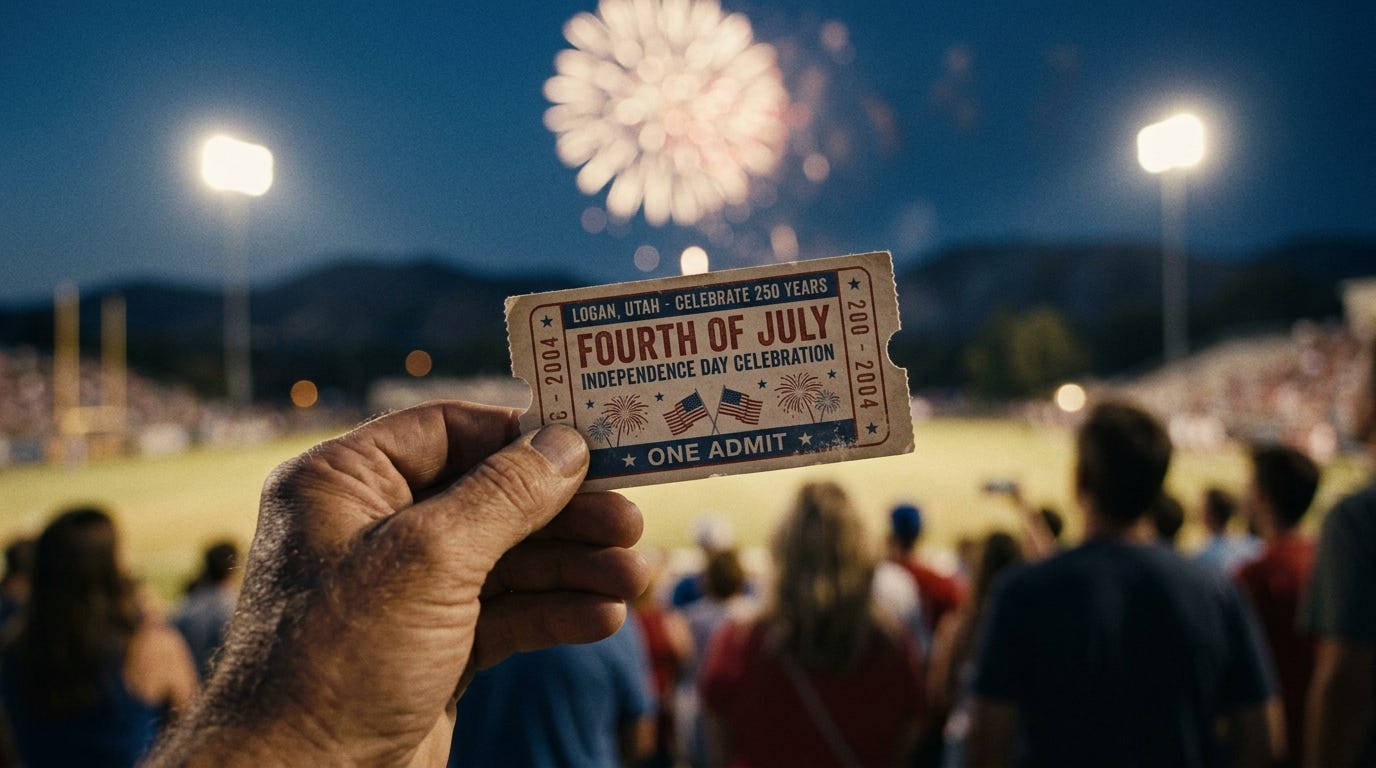
The following Fourth of July, the first one I would celebrate as a citizen, the management at ICON did something I did not expect. They gifted me a ticket to the town’s Independence Day celebration, held at a large stadium. The celebration was something you normally paid to attend, and they handed me a ticket without me asking, without any fanfare, just as a gesture. You are one of us now. Come celebrate with us.
I went. I sat in that stadium and watched the fireworks and listened to the music and felt something I had spent most of my life not feeling. I felt like I belonged somewhere.
That probably sounds simple to someone who has always had a country. But I had grown up a Kurd in Iraq, which meant growing up as something the country around you does not quite recognize, a foreigner in the only place you have ever known. When I left in the 1990s, I was not leaving a home. I was leaving a place that had never really claimed me.
America claimed me. Not through the document the INS issued, though that mattered too. It claimed me through a ticket handed over by people who had decided I was worth celebrating.
Two hundred and fifty years in, that is still what this country is capable of. I have not forgotten it.